Do Stretch Mark Creams Actually Work? An Honest Answer
If you are 28 weeks pregnant and googling this at midnight, you have probably already bought one cream that promised everything and did nothing. So let's start with the answer nobody in this category wants to give you:
No cream prevents stretch marks. No cream erases them.
What a cream can do is smaller and more useful: keep the skin hydrated, reduce the tight, itchy feeling of a belly that is growing fast, and make the surface look and feel better while your body does what it is going to do anyway.
What a stretch mark actually is
Stretch marks (striae) are tears in the dermis, the layer under the surface of the skin. When skin stretches faster than it can produce collagen and elastin, the fibers break. You see them as lines: red or purple at first, then pale and slightly indented.
They appear in 50–90% of pregnancies, usually in the third trimester, on the belly, breasts, hips and thighs. Whether you get them depends mostly on things you cannot control: your genes, your skin type, how fast your belly grows, and your hormones.
That is why a cream cannot prevent them. A cream works on the surface. The tear happens underneath.
So what are you paying for?
Hydration, mainly. And that is not nothing.
- Dry skin itches. Itchy skin gets scratched. Scratched skin looks worse. Keeping the belly moisturized breaks that chain.
- Well-hydrated skin feels more comfortable when it is stretched tight, especially at night.
- Some ingredients have evidence for improving the look of the surface over weeks, not days.
What the evidence says about the usual ingredients
Centella asiatica. The most studied botanical in this category. Extracts standardized to triterpenes (TECA) have small trials showing improvement in skin firmness and in the appearance of striae when used consistently. The effect is modest and gradual. It is a reasonable ingredient; it is not a treatment.
Hyaluronic acid. Holds water at the surface. It will not reach the dermis in a meaningful way from a cream, but it makes skin feel plumper and softer immediately. Three molecular weights (high, acetylated, hydrolysed) give a better finish than one.
Cocoa butter, shea, oils. Excellent for comfort and for dry skin. The evidence that they prevent stretch marks is weak and inconsistent. They feel good, which matters if you are going to use them twice a day for nine months.
Vitamin E. Popular, thin evidence for stretch marks. Fine as an antioxidant.
Retinoids. There is evidence for improving the appearance of existing stretch marks, and they are not for use during pregnancy. This is a postpartum conversation, with a doctor.
"Clinically proven" on a label. Ask which study, on how many people, measuring what. In this category the answer is usually: a manufacturer's own trial, 20 women, self-reported.
What actually makes a difference
- Time. Stretch marks fade on their own. Red ones fade to white over 6–18 months. This is the single biggest factor, and it costs nothing.
- Genetics. If your mother had them, you are more likely to. No product changes that.
- Managing the itch. Hydration, lukewarm showers, fragrance-free products, no wool directly on the belly.
- Not scratching. Easier said than done, but scratching makes the skin more irritated.
- After pregnancy: if they bother you a lot, talk to a dermatologist about options that actually remodel skin (laser, microneedling, prescription retinoids). Those are procedures, not creams.
What to look for in a belly product
- Fragrance-free. Fragrance is the most common cause of irritation in pregnancy products, and your skin is more reactive now.
- No drying alcohol (denatured alcohol, ethanol high on the list).
- A texture you will actually use twice a day. A heavy butter you avoid is worse than a light serum you use.
- A full ingredient list on the site, not just "botanical complex".
- Claims that match reality. If it says "prevents stretch marks", the brand is telling you something about itself.
Where our serum fits
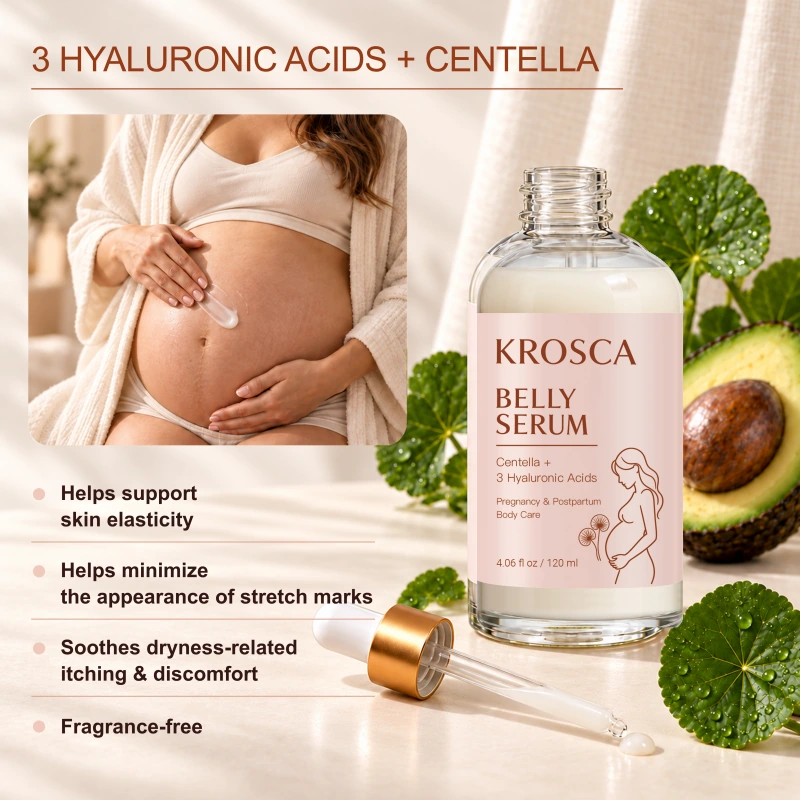
KROSCA Belly Serum is built for the honest version of this job: 0.75% centella extract, three hyaluronic acids, panthenol, squalane and avocado oil in a fragrance-free emulsion. It hydrates, it softens, it absorbs in about a minute, and it does not claim to do anything else.
If you want the daily step that makes the belly feel better for the next five months, that is what it is for. If you want a product that erases what is already there, no cream will give you that, and we would rather tell you now.
This article is general information, not medical advice. If you have severe itching, a rash, or itching on your hands and feet, talk to your doctor — see our article on itchy belly in pregnancy.